
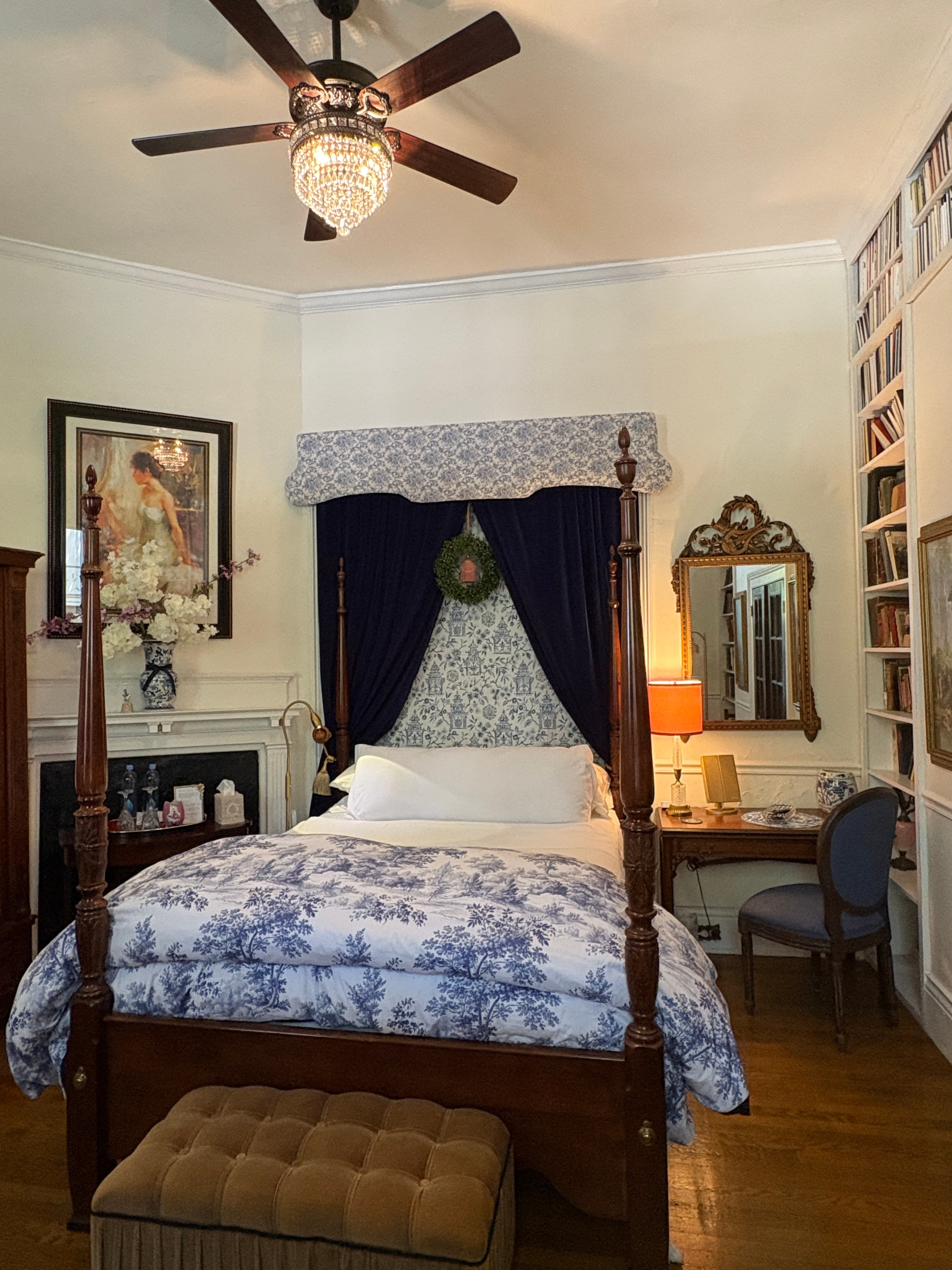
Hilton needed a word, so they made one. Hushpitality. Seeking sweet silence. In their 2026 trends report, “rest and recharge” beat every other reason people gave for taking a leisure trip — 56 percent. Nature, mental health, and “me time” followed. Two in five travelers now admit they pick a hotel based on whether they think they will sleep. Nearly half add extra days around a family trip just to be alone for a minute.
The industry wrapped it in a bow and called it sleep tourism. Fine. We have been running the unbranded version on Hampton Street since the mattresses arrived.
Chesnut Cottage is an 1850s house on a quiet street in a loud city. Downtown Columbia is right there — State House, USC, Main Street, Township Auditorium two minutes on foot. The trick, and it is a trick worth naming, is that guests keep telling us they never felt like they were in the middle of it. That sentence is the whole product. Walk to the noise. Sleep outside it.
What Quiet Luxury Is Not
Quiet luxury is not beige. It is not a no-photos policy taped to a barn. It is not a $2,000 night whose primary amenity is that nobody else can afford it. And it is not a wellness menu that requires you to drink chlorophyll at 6 a.m. in order to earn the bed.
Quiet luxury is subtraction. Take away the elevator ding. Take away the lobby playlist that thinks it is helping. Take away the ice machine that performs a one-act play at 1:40 a.m. Take away the corridor of forty identical doors. What is left should be a dark room, a serious mattress, water that is hot when you want it, and a morning that does not start with a buffet heat lamp.
Sleep tourism, stripped of the brochure, is even simpler. People are so tired they will travel in order to sleep. The Global Wellness Institute has been tracking sleep as a pillar of the wellness economy — a category measured in the hundreds of billions once you count mattresses, clinics, apps, and the trips built around rest. You do not need that TAM slide. You need to know that a growing share of guests will judge the entire stay on the night, not the neighborhood map.
The Centers for Disease Control has been saying for years that a third of American adults do not get enough sleep. You can feel that number in the way people check in. Bags down. Shoulders still up. They did not come to Columbia to collect a step count. They came because somewhere between the last two years of their life and this front porch, rest stopped being automatic.
If your house cannot win the night, no amount of historic plaque will save the review.
The Hardware of a Real Night
We learned this the expensive way. Guests will forgive a lot. They will not forgive a bed that lost the argument.
Every room at Chesnut Cottage has a handcrafted luxury mattress made for this house, not pulled off a hospitality catalog page. Adjustable Ergo-Systems bases, because two people in the same bed are not the same animal at 11 p.m. Premium linens. Plush towels. Robes that feel like they belong to the room. Private baths with Jacuzzi tubs — not as a gimmick, as the off-switch. A soak is still the cheapest, most reliable nervous-system intervention we have found that does not require a clinician.
Reviews keep using the same bored, grateful sentence: most comfortable bed of the trip. Sometimes of their lives. That is not us writing copy. That is people who have been in enough hotels to know the difference between “pillow-top” and sleep.
The small things do the rest of the work. A room that is actually dark. Climate that does not roar. A street that goes quiet after the last Main Street close. A porch if you need air. A garden if you need green. Warming eye masks and a tub that has been staged like someone expected you to use it. Coffee and tea in the room so you do not have to perform in a lobby at 6:15. Private check-in, so arrival is not a queue.
None of that photographs as loudly as a rooftop pool. All of it shows up at 3 a.m.
The Software: A House That Knows When to Stop Talking
Hardware without judgment is still a hotel. The inn part is knowing when to appear and when to vanish.
Our own line for the cottage has been “Time, Reconsidered.” Most travel asks you to rush — more stops, more photos, more proof you left the house. We do the opposite on purpose. The mind calms because the building is small enough to hear itself. Five or six rooms. Heart-pine floors. A garden under old trees. Breakfast at a table, not a trough. Conversation if you want it. Silence if you do not. Ken will talk your ear off about Mary Boykin Chesnut and the roses that bloom in October. He will also leave you alone on the porch with a cup and no agenda. Both are hospitality. Only one of them is currently in fashion. We intend to keep both.
That is hushpitality without the trademark. A host who can read a face. A house that does not require an app to dim the lights in your soul. Analog on purpose — not as a stunt, as a standard.
Who This Night Is For
Baby Boomers. You already know what bad sleep costs. You will pay for a mattress, a tub, and a street that does not honk. You want competence, cleanliness, and a human at the door. Quiet luxury is just the name someone under forty put on the stay you have been booking for twenty years.
Millennials. You did the packed itinerary. You did the rooftop. You did the 14-item Saturday. You are tired in a way a hike will not fix. A historic inn with a serious bed and a walkable downtown lets you have the city without wearing it to bed. That is the product you will actually recommend.
Gen Z. Silence is status now. In a culture that performs volume, the ability to disappear into a beautiful room is the flex. You still want the photograph — the garden, the china, the tub. You do not want the room to need a ring light. Taste, not noise.
Solo travelers already understood this. A quarter of people plan to travel alone in 2026; more add a night of solitude onto a family trip. Business travelers sneak extra sleep instead of the obligatory group dinner. An inn is built for that guest. You are not rattling around a 300-room property hoping the “quiet floor” was not a rumor.
Downtown Quiet Is a Specific Skill
Rural silence is easy. A cabin in the woods does not have to try. The harder trick — and the one that makes a historic downtown inn worth the rate — is quiet next to everything.
Chesnut Cottage sits in the Robert Mills Historic District at 1718 Hampton Street. Guests walk to the State House, the USC Horseshoe, Main Street restaurants, Township Auditorium, museums. They ride to Colonial Life Arena and Williams-Brice when the calendar demands it. Then they come back to a residential street that behaves like one. No porte-cochère. No valet stand arguing with a rideshare. Parking behind the house. A garden that does not face a loading dock.
That geography is why sleep tourism works here instead of only at a mountain spa. You can have a full Columbia day — football, a show, a kid on campus, a long dinner — and still win the night. The cottage is not asking you to choose between the city and rest. It is the hinge.
Fall makes the argument easier. The air drops. The house gets dressed. Breakfast leans warmer. Legislative session is over until January. The garden keeps its manners. If you have been waiting for a reason to take a staycation twenty minutes from your own bed, this is the season the nervous system votes for.
Locals already know this. A quiet luxury night does not require a boarding pass. It requires a door you do not have to keep listening for. We watch South Carolina guests arrive on a Thursday, take the tub seriously, skip the encore on Main Street, and look ten years younger at breakfast. That is sleep tourism with a short drive and no airport carpet.
A Night, Written in Order
Arrive. Park. Someone meets you. The room is already the temperature a person would pick. The tub is not a footnote in the listing; it is the first decision after you drop the bag. Fill it before dinner or after — there is no wrong order, only the mistake of treating it like décor. Dinner on Main Street or in the Vista — walk if you can. Back to the porch. Garden if the night is doing something. Phone face-down. The house is old enough that it does not need to prove it.
Sleep. This is the part the trend reports keep circling and hotels keep underbuilding. Adjust the base. Let the mattress do the job we paid a craftsman to do. No ice machine. No door slams from room 412. No elevator announcing 4.
Morning. You do not hunt for coffee in a grab-and-go alcove under fluorescent light. You come to the table when you are ready. Vintage china. Something cooked. Conversation optional. The day can be loud after that. The night already paid you back.
That sequence is the stay. Everything else — the Civil War diary, Jefferson Davis on the front steps, the National Register listing from 1971 — is the soul of the house. The night is the body. Guests fall in love with both. They rebook because of the bed.
If You Are Building This Kind of House
A short note for the person reading this as an operator, not a guest. Quiet luxury is not a throw-pillow strategy. It is capital in the dark.
Spend on the mattress first. Then the base. Then blackout, HVAC, and water pressure. Then the tub. Then the street — meaning site selection, not a white-noise machine. Then the host behavior: fewer scripts, better timing. Breakfast should lower the pulse, not spike it. If your inn requires a QR code to feel premium, you built the wrong inn.
The trend will get louder. Chains will add “sleep suites” and a partnership with a meditation app. That is fine. An 1850s cottage with six rooms, a garden, and a mattress made for the building does not compete with a sleep suite. It is the thing the suite is trying to photocopy.
The Unfashionable Close
We are not going to tell you to come here to heal your entire life. That is a different industry and a different invoice. We will tell you that a lot of people arrive wound up and leave having remembered what an uninterrupted night feels like. Sometimes that is the whole trip. Sometimes it is the reason they can enjoy the rest of Columbia.
Hushpitality is a 2026 word for an old idea. Sleep tourism is a 2026 word for booking the night on purpose. Quiet luxury is a 2026 word for not decorating over the silence.
The cottage has been practicing all three. If that is the stay you have been trying to describe to a search bar, reach out to Christal or to Ken. Tell us how you sleep. We will put you in the room that takes that sentence seriously.